

When you purchase life insurance linked to a mortgage, one of the most important decisions is choosing the type of disability coverage: IAD (Total and Permanent Disability) or TDI (Total and Permanent Disability).
This choice may determine whether or not the insurance pays out the outstanding balance in the event of a serious health problem.
In this comprehensive guide, we explain:
- The Real Difference Between IAD and ITP
- Which one offers more protection?
- What Banks Require
- Real-world case studies
- How to Activate Coverage in the Event of a Claim
Quick Comparison Between IAD and ITP (Direct Answer)
IAD vs. ITP — A Simple Summary
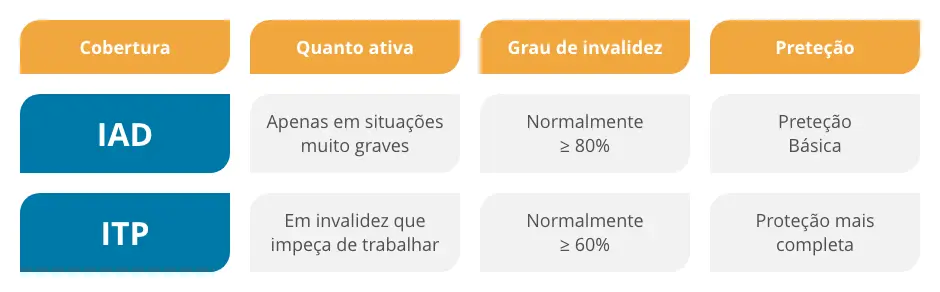
Quick conclusion:
A ITP covers many more situations than IAD, although it costs a little more.
What is IAD (Total and Permanent Disability)?
IAD is the most restrictive (least comprehensive) coverage.
It only activates when the person:
- The person is left with a very high level of disability (usually above 80%, but it is difficult to specify an exact percentage)
- You become completely dependent on others
- Is unable to work in any profession
- Is unable to perform basic activities of daily living
In practice, IAD functions almost like a situation of dependency and is treated as an extreme case for insurance purposes.
Typical examples of IAD situations
- Vegetative state
- Quadriplegia
- Severe, disabling neurological diseases
- Severe brain injuries
- Permanent total disability
Because this is a more limited type of coverage, the insurance premium tends to be lower.
What is ITP (Total and Permanent Disability)?
A ITP It provides much more comprehensive coverage.
Enable when:
- Disability is typically ≥ 60% (depending on the company)
- The person is no longer able to practice their profession
- There is a significant loss of work capacity
This means that You don't have to rely on others.
All it takes is being unable to work, which results in a loss of income.
Case Studies: When to Use IAD vs. ITP
Case Study 1
A person suffers a stroke and is left with a 65% disability rating, forcing them to retire on disability.
Result:
- IAD → inactive
- ITP → active
ITP insurance would pay off your mortgage to the bank or pay the principal amount to the insured (if the policy is not linked to a mortgage).
Not the IAD.
Case Study 2
A person suffers a serious accident and becomes completely dependent on others.
Result:
- IAD → active
- ITP → active
Under an insurance policy covering IAD or ITP, it would be possible to file a claim under this policy.
Please note that coverage cannot be claimed for multiple policies at the same time: for example, once a claim is paid under ITP, it will not be paid under IAD as well.
Case Study 3
A person develops a degenerative disease that prevents them from continuing to work, but they retain their personal autonomy.
Result:
- IAD → inactive
- ITP → active
This is the most common scenario where the choice makes a difference.
Why do banks prefer ITP?
Today, most banks prefer or recommend ITP because:
- Reduces the risk of default
- Provides better protection for the customer
- Increases the likelihood that the insurance will pay out
Some institutions require:
- ITP 60%
- ITP 65%
This may directly affect whether your loan is approved.
According to the Bank of Portugal, life insurance must provide adequate protection against the risk of the borrower becoming disabled.
You can view the official recommendations at Bank of Portugal website.
How the choice between IAD and ITP Affects the Price of Insurance
On average:
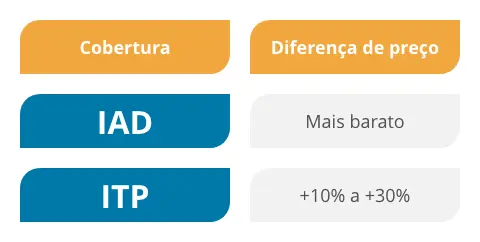
But be careful:
Choosing IAD just to pay less could be a serious financial mistake.
The real risk is: to be disabled and for the insurance not to pay out.
Therefore, the choice should be based on protection, not just price.
You can better understand how a → works life insurance, mortgage insurance on the page: Mortgage Life Insurance
ITP for domestic workers—does it exist?
Yes.
Even without a formal occupation, ITP can apply to domestic workers.
Some insurance companies consider:
- Inability to perform household activities
- Loss of functional independence
- Medical Assessment of Disability
Each insurance company has its own criteria.
That is why it is important to conduct a personalized analysis with a specialized mediator such as EXS Insurance.
You can request an analysis here: Life Insurance Simulation
ITP for retirees — is it possible?
It depends.
If the retiree:
- Continue working
- Has a paid job
- It has business operations
- You are within the subscription age range
ITP can be considered based on this activity.
If the insured is not employed, insurance companies:
They limit coverage to IAD.

What do lenders require for disability coverage?
They usually require:
- Principal equal to the amount of the loan
- Death Coverage
- Disability Coverage
- Preferred ITP
Some factors that influence this:
- Age
- Occupation
- Amount Financed
- Medical risk
What is required to activate IAD or ITP in the event of a claim?
Typically, you will need:
Medical documents:
- Detailed medical report
- Multi-purpose certificate of incapacity
- Clinical Exams
- Medical History
Administrative documents:
- Deductible
- Identification of the Insured
- Policy Number
- Employer's Statement (if applicable)
- Proof of retirement
The degree of disability is typically assessed based on:
National Table of Disabilities
You can check it out here: National Disability Classification Table (Official Gazette)
IAD or ITP: Which Should You Choose?
In most cases:
ITP is the safest choice.
Because:
- Use it in more situations
- Protects income
- Reduces financial risk
- It is more likely to be triggered
IAD is only appropriate when:
- Price is a critical factor
- Advanced age
- Medical conditions limit ITP
Frequently Asked Questions (FAQ)
Is ITP better than IAD?
Yes. The ITP covers more types of disability.
Is it worth paying more for ITP?
In most cases, yes, because it greatly increases the likelihood that the insurance company will pay out.
Can I switch from IAD to ITP?
Yes, subject to a new medical evaluation.
Can the bank require ITP?
It may require a minimum level of protection.
Conclusion
The difference between IAD and ITP can determine whether your family receives the payout if you develop a more serious illness that prevents you from working.
- IAD = minimum protection
- ITP = recommended protection
The choice should be based on actual protection, not just on cost.
In the EXS Insurance, each analysis is conducted on a case-by-case basis, taking into account:
- Risk
- Occupation
- Age
- Credit
- Protection Objectives
If you'd like to find out which option is best for you, you can request an expert analysis here:
Personalized analysis of life insurance and mortgage coverage.