


Life, Credit, and Housing
Life Insurance with IAD or ITP: Expert Advice for You
When it comes to disability protection, life insurance policies offer two types of coverage: Absolute and Permanent Disability (IAD) and Total and Permanent Disability (ITP). Choosing the right option between these two ensures you have the coverage best suited to your needs. In this article, we’ll explain what you need to know to choose a Life Insurance with IAD or ITP.

Find out what kind of coverage the IAD and ITP policies provide
Both Total and Permanent Disability (TPD) coverage and Total and Permanent Disability (TPD) coverage protect against risks related to disability; however, there are significant differences between them. Let’s take a look:
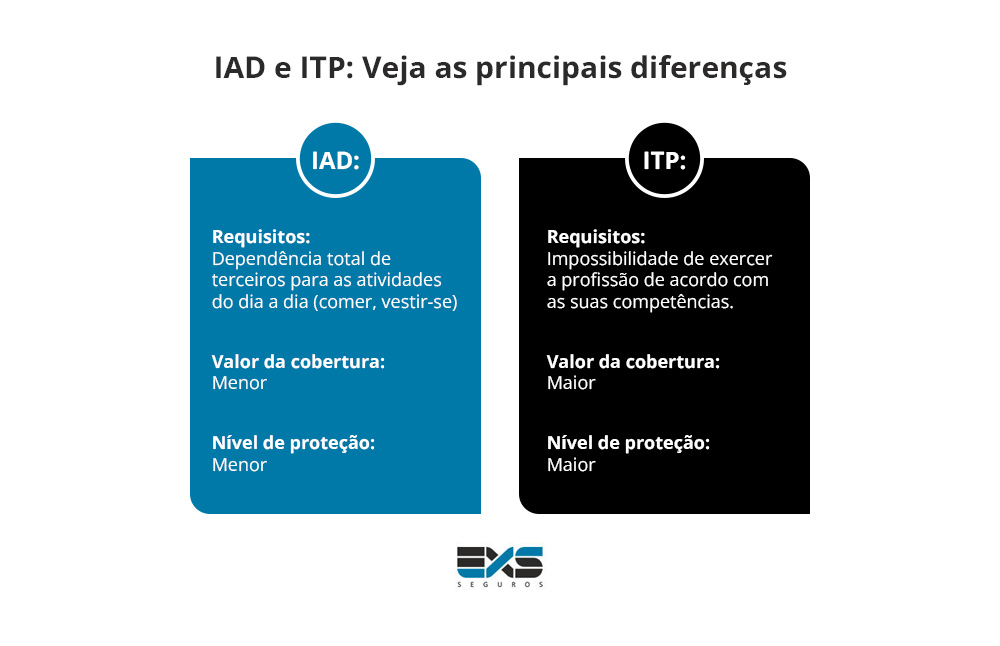
Absolute and Permanent Disability (IAD):
Under this coverage, the Insurer pays the Insured Amount when, as a result of an accident or illness, the Insured becomes dependent on a third party to perform daily activities, such as eating or dressing, and is also permanently unable to engage in any type of paid work.
This coverage provides protection only in extreme cases of disability, in which the Insured is dependent on another person to perform daily tasks.
Total and Permanent Disability (TPD):
In this case, coverage is provided in the event of a permanent and definitive inability to perform professional activities in accordance with the Insured’s technical expertise, with no possibility of clinical improvement.
This coverage offers broader protection compared to that of IAD.
Dependence on another person to perform basic tasks is no longer a requirement. Protection is also greater in the professional sphere, since the disability relates to the Insured’s professional activity, in accordance with their technical skills, whereas in the case of IAD, we are referring to any paid activity.
In order for these benefits to be paid, insurance companies require the submission of a general medical certificate that specifies the degree of disability, as well as whether the disability is temporary or permanent, with no possibility of medical improvement.
What to Consider When Choosing Between IAD and ITP
The definitions of IAD and ITP vary depending on the insurance company you choose, which is why it is essential to carefully review these coverages.
There are four points that deserve special attention, and a careful analysis can lead to better protection for you and your family. Take a look:
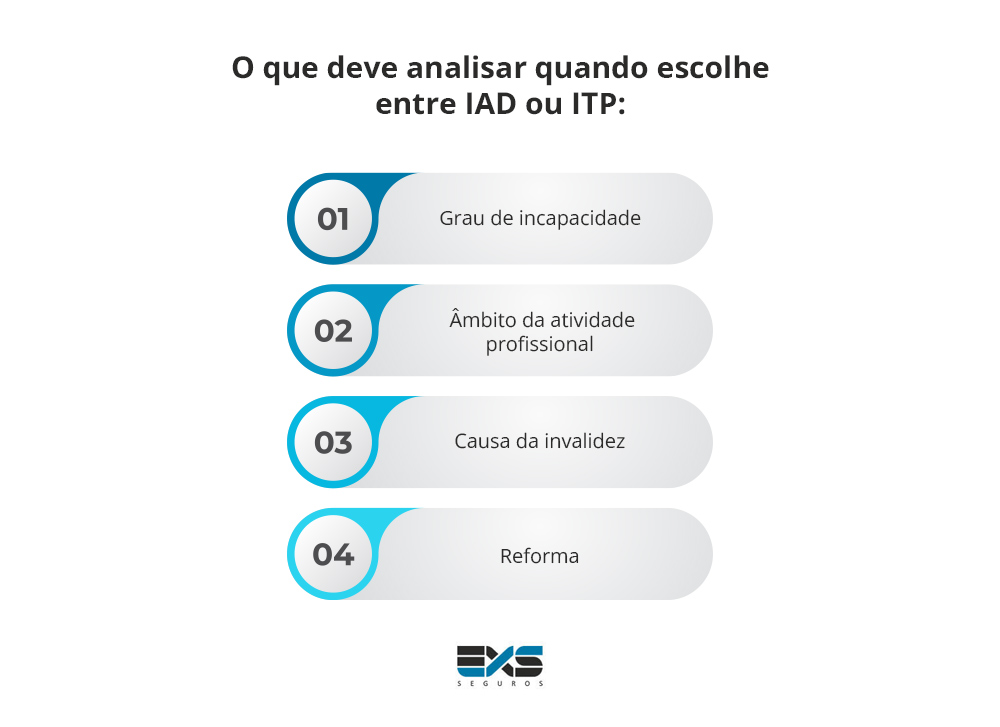
– Degree of disability
Some insurance companies link degrees of disability to Temporary Total Disability (TTD) or Temporary Partial Disability (TPD) coverage, requiring that the insured’s disability reach the levels defined in the policy.
For example, in the case of TDI coverage: the Insured may be dependent on a third party, but in order for the benefit to be paid, it must be proven that the Insured’s disability meets the percentage threshold set by the Insurer.
Some insurance companies require a disability rating of around 85%, and some even go as high as 95%.
For ITP coverage, the required degree of disability is generally lower and ranges from 60% to 75%.
– Scope of professional activity
In the case of ITP coverage, the main benefit relates to protection in situations of disability where the Insured is no longer able to perform their professional duties in accordance with their technical skills.
However, there are insurance companies that offer ITP coverage for any profession. This means that, in order to receive compensation, the insured person must be unable to perform any type of professional activity.
– Cause of disability
Some insurance companies differentiate between the causes of disability when it comes to temporary total disability (ITP) coverage, so you should check whether the policy covers both accidents and illnesses. If, for example, the policy covers only accidents, disability resulting from illness is excluded from the payment of the insured amount.
– Renovation
By definition, disability insurance protects the insured in cases of disability where they are unable to perform their professional duties. If you have already retired and are no longer working, this type of coverage is no longer relevant to you.
If you are retired and have ITP coverage, we recommend that you contact your insurance company and ask them to make the necessary changes.
How to Choose Between IAD and ITP, Step by Step
Now that you've reviewed all the points to consider when evaluating IAD or ITP coverage, you need to know how to make the right choice between these two types of coverage.
### Step 1: Financial Stability
The first step is to reflect on your financial stability by asking yourself a simple question:
**If you have to stop working due to a disability, do you have the financial means to cover your expenses? **
Expenses should include both ongoing costs and loan payments, in the case of life insurance linked to a mortgage.
If the answer is no, we recommend that you choose ITP coverage, even if this means an additional financial burden on your monthly premium. Purchasing IAD coverage in these cases is a risk that can be avoided.
### Step 2: Degree of disability
The next step is to assess the degree of disability associated with IAD or ITP coverage. As we have seen, this assessment is very important for ensuring broader protection.
If you've chosen the ITP, there are two more steps to complete:
### Step 3: Scope of Professional Activity
Next, check the scope of the professional activity and see whether the ITP applies to the declared professional activity or to any type of profession.
### Step 4: Causes of disability
Finally, check to see if the causes of disability include both accidents and illnesses.
Do you need help deciding between IAD and ITP?
The decision regarding IAD or ITP coverage should be made carefully so that you can be sure you have the best protection for your specific situation.
If you need help deciding between IAD and ITP, request one now Life Insurance Simulation To EXS. With over 25 years of experience in the insurance market, our professionals have the expertise needed to find the best disability coverage for your situation, ensuring comprehensive protection tailored to your needs.
EXS searches on its own for the best deals among the country's 26 largest insurance companies to find the solution that best fits your profile. At no cost and with complete impartiality.
Contact EXS today.